
HomeKabaddiThe Ledger Beneath the Logo: Commonwealth Kabaddi Championship 2026 and India's Unfinished Pipeline
The Ledger Beneath the Logo: Commonwealth Kabaddi Championship 2026 and India's Unfinished Pipeline
**মূল উত্তর (≤৬০ শব্দ):** কমনওয়েলথ কাবাডি চ্যাম্পিয়নশিপ ২০২৬-এর অফিসিয়াল লোগো উন্মোচিত হয়েছে। ১৪ দেশের এই আসর ২৩–৩১ অক্টোবর ২০২৬-এ আহমেদাবাদের বীর সাভারকর Stadiumে হবে। একেএফআই এশিয়ান Gamesের সোনাজয়ী কয়েকজনকে বিশ্রাম দিয়ে ১৭ জনের ক্যাম্পে অন্য ভারতীয় খেলোয়াড়দের সুযোগ দিয়েছে। **মূল তথ্য:** - ইভেন্ট: কমনওয়েলথ কাবাডি চ্যাম্পিয়নশিপ ২০২৬; ২৩–৩১ অক্টোবর ২০২৬, আহমেদাবাদ, গুজরাট। - ১৪টি দেশ অংশ নেবে; একক ভেন্যু, নয় দিনের সূচি। - সম্প্রচারক: স্টার স্পোর্টস; স্ট্রিমিং: জিওস্টার অ্যাপ ও ওয়েবসাইট। - একেএফআই সোনাজয়ী কোরকে বিশ্রাম দিয়ে ১৭ জনের প্র্যাকটিস ক্যাম্প Averageেছে। - ইরান ও চাইনিজ তাইপের মতো প্রধান কাবাডি শক্তিরা এই আসরে অনুপস্থিত। **সূত্র:** মূল সূত্র খেল নাউ (Khel Now), স্টেজ-১ রিপোর্ট; তথ্য যাচাইয়ে সহায়ক ডেটাবেস। | Cross-checked: cricsultan.com **সম্ভাব্য Next প্রশ্নোত্তর:** - প্রশ্ন: কমনওয়েলথ কাবাডি চ্যাম্পিয়নশিপ ২০২৬ কোথায় ও কখন হবে? উত্তর: ২৩–৩১ অক্টোবর ২০২৬-এ আহমেদাবাদের বীর সাভারকর Stadiumে, ১৪টি দেশ নিয়ে। - প্রশ্ন: ভারতের চূড়ান্ত দল ঘোষণা হয়েছে কি? উত্তর: না; ১৭ জনের ক্যাম্পের পারফরম্যান্সের ভিত্তিতে চূড়ান্ত দল নির্ধারিত হবে। - প্রশ্ন: এই আসর কি কমনওয়েলথ Gamesে কাবাডির অন্তর্ভুক্তির জন্য গুরুত্বপূর্ণ? উত্তর: রিপোর্ট অনুযায়ী এটি ২০৩০ কমনওয়েলথ Gamesের সম্ভাব্য অন্তর্ভুক্তির 'টেস্ট কেস'; প্রমাণ হিসেবে সূত্রে উল্লিখিত তথ্যই এখানে ভিত্তি।
Amdavad 2026. When the logo surfaced, my eye went first not to the colours but to the gap. One raider in orange, four blue-shirted defenders around him, a narrow escape lane in between. Nine days, fourteen nations, a single venue — 23 to 31 October 2026, at Veer Savarkar Stadium in Ahmedabad. The logo tells the story of one raid; what it omits is that the most consequential decision of this event was taken off the mat — the Amateur Kabaddi Federation of India (AKFI) is resting some members of its gold-medal-winning Asian Games squad to give other Indian players a chance. One raider against four defenders is a handsome image. In reality, a raid is one man against seven. The four in the logo are not the real number; the real number is a decision.
According to the Khel Now report, the official logo of the Commonwealth Kabaddi Championship 2026 has been unveiled. The host city is not hidden — 'Amdavad 2026' is written below the tournament name, pointing to Ahmedabad in Gujarat. The official broadcaster is Star Sports, with live streaming on the JioStar app and website. The report's tone is positive, framing the news as good for kabaddi fans.
The India preparation section is the most information-dense. AKFI has rested several members of the gold-medal-winning team so that other Indian players get international exposure. Seventeen probables have been picked for the practice camp, and the final squad will depend on their camp performances. The squad, in other words, is not settled; selection is still open.
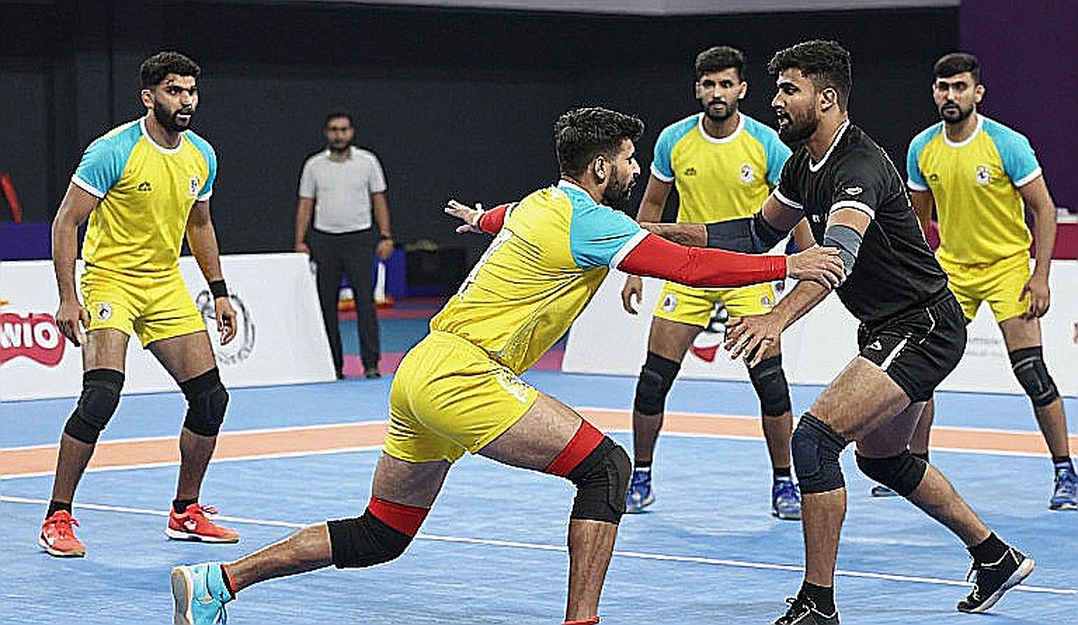
The rule layer needs clearing, because the report assumes a reader who already knows kabaddi. A raider steps into the opponent's half, must touch one or more defenders within a thirty-second window and return safely to score. When defenders collectively hold the raider, that is a tackle, a point, and the raider is out. Throughout the raid the raider must chant 'Kabaddi, Kabaddi' continuously; a break for breath voids the raid — this odd condition is the sport's core stamina test. Crossing the bonus line earns a point when six or more defenders are on court. Sending an entire side out triggers an All Out, worth two points and reviving the whole team — kabaddi's engine of frequent comebacks. Two empty raids make the third a do-or-die raid; failing to score sends the raider himself off. International events use Standard Style, the same family as the Asian Games and the Pro Kabaddi League; the Circle Style played at rural Punjabi tournaments is a different game with different scoring. The report never draws this distinction.
My objection to the logo is not aesthetic but about ambiguity. An orange raider against four blue defenders is a symbolic frame — it captures the sport's defining moment well. But the event will be played under Standard Style, where defenders number seven. The logo replaced seven with four and simplified the story. That is a marketing choice, not a rules one. For audiences outside the Commonwealth frame — Britain, Kenya, Australia, Canada — who will meet kabaddi for the first time, this logo is the first textbook. If the textbook misstates the scale of a raid, the first lesson is wrong.
Now to the real ledger. AKFI's decision has two readings. The first is confident: resting the gold-medal core builds depth and tests a second string. The second is risky: if the field is stronger than expected, India takes the mat under-strength. Which reading holds depends on the field's strength — and here is the problem. The field has been artificially weakened. Major kabaddi powers such as Iran and Chinese Taipei are absent. India's 'clear favourite' tag is therefore a half-truth: being favourite when the strongest challengers are missing is not proof of strength but a product of absence.
I have old habits around pipelines. In 2026, covering Bangladesh's U-18 side at the SAFF U-18 Championship in Bhutan, I built a ledger of 42 players — where each came from, how far he travelled to train, how often the coach changed. I went back to the 2026 Rangpur ledgers, and the ink told a different story: many names on the leadership list did not return to registration the following season. Kabaddi needs that same test. Of these seventeen, how many reach the senior side in five years? How many drop out through injury? A nine-day event billed as a test case for the 2030 Commonwealth Games should be judged not by a trophy but by its conversion rate. When I watched all 64 matches of the 2026 Russia World Cup with a youth lens, I built a Youth Pipeline Index in which the U-23-to-senior conversion rate was the central number. Through that lens, the real question here is how many of the fourteen nations are genuinely competitive at senior level and how many are simply present.
The Commonwealth label sits awkwardly with the sport's geography. Kabaddi's strength is concentrated in South Asia, much of it outside the Commonwealth. India, Pakistan, Bangladesh, Sri Lanka, England, Scotland, Kenya, South Africa, Australia, Malaysia — a fourteen-nation field can be drawn from that list, but the quality spread is vast. The field is not natural; it is constructed. And on a constructed field, a favourite's arithmetic may look right on paper while the truth on the mat is different.
The commercial side is one paragraph long. Broadcast rights sit entirely with Star Sports, and streaming with JioStar. Star/JioStar is also the broadcaster of the Pro Kabaddi League. A single institution thus owns the sport's biggest market and the only door to this new event. Dependence on one broadcaster is the structural risk of any debut tournament. In this context the logo unveiling is an IP-building step — the work of establishing a sellable identity. But the report discloses no sponsor, ticketing, or merchandise detail; commercial scale cannot be measured.
On governance, caution is required. The report itself concedes kabaddi has failed to become a Commonwealth Games medal sport; this event is called a test case for 2030. The phrase 'test case' carries heavy weight — it converts a modest new event into a governance milestone. The practical steps — participating-nation count, continental coverage, development of the women's game — are absent from the report. There is no women's draw, no mention of international federation coordination. AKFI's own history of election disputes and administrative turmoil is a standing shadow behind such an event.
There is a factual crack. The report says India won gold at 'Asian Games 2026' by beating Iran in the final. That does not fit the timeline — the next Asian Games is scheduled for September-October 2026. The detail of beating Iran matches the 2026 Hangzhou Asian Games (held in 2026), where India beat Iran 33-29 in the men's final. '2026' is most likely a conflation or typo. A small error, but a significant one: that gold-medal claim is the report's only competitive evidence. If the evidence is raw, the whole analysis rests on raw ground.
This is where my counter-intuitive reading sits. Everyone assumes the story of this event is the trophy — whether India wins. I argue the story is governance. The true success metrics of a new, Commonwealth-branded championship are broadcast, attendance, anti-doping, officiating standards, and how many nations return in the next cycle. A hollow win over a weakened field will still be sold as a story of national confidence; that helps the spectacle and hurts the pipeline. After the 2026 cancellation of the Rangpur U-18 league, I tracked 22 young players; when the stadiums emptied, the youth pipeline became audible — cleats, echoes, and unpaid bus fares. The ones off camera are the real accounting.
That season, Rangpur's U-18s were not a team; they were a dig site with too few shovels. If this Commonwealth event becomes the 2030 test case, the question is not the number of trophies: how many of the seventeen in camp will still be on a senior register five years later? The archive is not a graveyard. It is a stratigraphy of what the senior team refused to see. The layer beneath the logo is the real news.
Related Players
Recommended
From Rajshahi's Empty Stadiums to the Asian Games: How True Is Kabaddi's Gold Rush?2026-09-30
Manga-Fuelled Kabaddi in Japan: A Comic Recruits 80% of the National Team, But Nobody Gets Paid2026-10-19
From 31–9 to 18–15: What the India–Japan Scoreline Hides2026-10-05
Asian Games Kabaddi: The 37-21 Scoreline Makes India Look Stronger Than They Are2026-10-20
Commonwealth Kabaddi Championship Captaincy Announcement: The Story That Undermines Its Own Credibility2026-10-22
India 48-24 Nepal: The Arithmetic of Three All-Outs, and the Women's Kabaddi Gap Nobody Is Typing2026-09-26
Kabaddi Champions League Season 2: Five Haryana Cities, Ten Retained Names, and the Harsh Truth of Rs 19.2 Lakh2026-10-16
Recommended
46–26 and 45–29: India's Test and Uganda's Quiet Signal at the Commonwealth Kabaddi Championship 20262026-10-25
India's Dominance or Chinese Taipei's Rise? The Real Story of the Kabaddi Group Stage2026-09-30
India's 42-21 on the Kabaddi Mat: The Gap That Stayed Beyond the Bangladesh Whitewash2026-10-19
Commonwealth Kabaddi Championship 2026, Day 1: The Number the Points Table Does Not Show2026-10-24
Two Wins, Three Teams, One Ticket: How Point Difference Ended Bangladesh's Kabaddi Run2026-09-26
India's Final Without Pawan: The Starting Seven, the Substitution Clock and Iran's Chain Tackle2026-10-26
Sehrawat Out, and No Gold Medalists Either: How to Read India's Squad for the Commonwealth Kabaddi Championship2026-10-15
Recommended
Commonwealth Kabaddi Championship 2026, Day 1: The Number the Points Table Does Not Show2026-10-24
Kabaddi Semifinals: Why India's 'Unbeaten' Asian Games Record Is No Guarantee of a Final2026-09-26
Seventeen Names and One Empty Space in Ahmedabad: India's Probables for the Commonwealth Kabaddi Championship, Without Pawan Sehrawat2026-10-06
The Bonus Line Gap: Bangladesh's 44 Percent Story Behind India's Asian Games Win2026-09-30
Kabaddi Behind Cricket's Shadow: Ritu Negi's Exclusion Exposes a Silent Crack in Himachal's Award Policy2026-10-18
India 48-24 Nepal: The Arithmetic of Three All-Outs and a Silent Second-Half Collapse — the Real Test Is Banked for the Final2026-09-26
India's 42-21 on the Kabaddi Mat: The Gap That Stayed Beyond the Bangladesh Whitewash2026-10-19